
How Brainspotting Therapy Can Accelerate Your Path to Healing
You've Been Doing the Work. So Why Does Healing Still Feel So Far Away?
You're not someone who gives up easily. You've shown up to therapy, journaled, read the books, and maybe even built a successful career or family — all while carrying weight that most people around you never see. But somewhere inside, there's still that familiar tightness in your chest, the hypervigilance, the moments when the past sneaks into the present and pulls you under.
If that resonates, you're not broken. And you're not alone. Many of my clients — high-achieving adults, people of color, and adult children of immigrants — come to therapy having already done significant work, yet still feeling like true peace is just out of reach. The missing piece often isn't effort. It's the method.
That's where brainspotting therapy comes in. This innovative, research-supported approach goes beyond words to address trauma where it actually lives — in the body and the brain. And for many clients, it produces results that feel almost impossibly fast compared to traditional models.
Why Healing Can Take So Long in Traditional Talk Therapy
Traditional talk therapy is valuable. It helps you understand your patterns, name your experiences, and develop coping strategies. But there's an inherent limitation: trauma doesn't live in the part of the brain that processes language.
When you've experienced trauma — whether it's the chronic, layered kind that comes from growing up navigating racism, immigration stress, or family dysfunction (what we call complex trauma), or more acute events — the survival brain encodes those experiences in ways that talking alone can't always reach. You can intellectually understand why you feel anxious in certain situations and still feel completely unable to change the response.
Add to that the cultural context many of my clients carry: the immigrant family ethos of "push through and don't complain," the pressure of being the first in your family to achieve a certain level of success, or the exhausting labor of code-switching in predominantly white professional spaces. These aren't issues that resolve with a few sessions of reframing thoughts. They're woven into how your nervous system learned to survive.
In a traditional 50-minute weekly session, you might spend 20 minutes catching up, 20 minutes exploring a pattern, and 10 minutes wrapping up. Deep emotional processing — the kind that actually rewires your nervous system — rarely happens in that window. And so healing becomes a slow accumulation, measured in years rather than months.
How Brainspotting Therapy Speeds Up Progress
Brainspotting was developed by Dr. David Grand in 2003 and has since been used effectively with trauma survivors, high performers, and people seeking deeper emotional healing. The core principle is elegantly simple: where you look affects how you feel.
In a brainspotting session, your therapist helps you identify a "brainspot" — a specific eye position that activates the neural networks where your trauma or emotional pain is stored. While holding that eye position and staying with the body sensations and emotions that arise, the brain begins to process and release what's been stuck. This isn't something you have to consciously direct or talk yourself through. The brain does the work it already knows how to do — it just needs the right conditions.
Think of it like this: traditional therapy often tries to access a deep underground spring by digging each layer at a time, slowly from the top. Brainspotting finds the natural fissure in the rock and lets the water move through on its own.
Here's what makes the benefits of brainspotting especially powerful:
- It bypasses the thinking mind. You don't have to have the "right" words or a coherent narrative. You just have to be present with your experience.
- It works with the body's wisdom. Complex trauma and cultural stress live in the nervous system. Brainspotting speaks that language directly.
- It doesn't require you to re-tell the story in detail. For clients who've felt retraumatized by recounting difficult events, this is genuinely freeing.
- It can reach experiences that predate language — early childhood experiences, intergenerational patterns, and pre-verbal trauma.
The result? Many clients report meaningful shifts — reduced anxiety, greater emotional regulation, a new sense of inner calm — within just a handful of sessions. That doesn't mean the work is done, but the quality of the movement is different. Deeper. More embodied. More lasting. This is the heart of faster healing through brainspotting.
Who Benefits Most from Accelerated Healing Through Brainspotting
Brainspotting isn't for everyone in every moment — but for the right person at the right time, it can be genuinely transformative. Here's who tends to experience the most powerful results:
High Achievers Carrying Hidden Burdens
Imagine someone who, on paper, has everything together — a demanding career, a loving family, financial stability. But beneath the surface: chronic anxiety, imposter syndrome, and a nagging sense of unworthiness that no amount of external success can quiet. Often, this pattern traces back to childhood experiences of having to perform for love or safety. With brainspotting, clients can access and release those early emotional memories without having to analytically reconstruct them. The change often shows up first in the body — a loosening, a lightness — before it becomes conscious thought.
People of Color Healing from Racial Trauma and Cultural Stress
Racial trauma is real, and it's cumulative. Microaggressions, systemic discrimination, and the exhaustion of existing in spaces that weren't built for you create a kind of chronic stress that settles deep in the nervous system. For clients navigating this, brainspotting offers a culturally attuned pathway to process what hasn't been safe to express — grief, rage, fear, loss — in a space where those feelings are met with full validation, not minimized or over-intellectualized.
Adult Children of Immigrants
Growing up between two worlds — honoring your family's sacrifices while building your own identity — creates a unique kind of psychological tension. Many adult children of immigrants carry layered complex trauma: the family's immigration story and loss, the pressure to succeed as a form of gratitude, the grief of cultural disconnection, and sometimes the weight of being the family's emotional translator and financial anchor. Brainspotting can reach into those layered experiences and begin to untangle them, often allowing clients to feel — for the first time — that they can belong to themselves.
Those Ready to Make a Significant Life Shift
Sometimes clients come to therapy at a crossroads — a relationship ending, a career transition, a health crisis, or simply an undeniable inner knowing that something needs to change. For these clients, the urgency is real and the window is now. Brainspotting's accelerated timeline is particularly valuable here, supporting deeper processing in a compressed timeframe.
People Who Feel "Stuck" Despite Previous Therapy
If you've done therapy before and feel like you've gained insight but the emotional pain hasn't shifted — this is often a sign that the work needs to go beneath cognitive processing. Brainspotting is frequently the modality that unlocks what years of talk therapy couldn't, not because talk therapy failed, but because the stored trauma required a different key.
You Don't Have to Wait Years to Feel Like Yourself
Healing doesn't have to be a decade-long project. It can be deep, meaningful, and genuinely fast — especially when the approach matches the depth of what you're carrying.
If you're ready to stop managing your symptoms and start truly moving through them, I'd love to explore whether brainspotting therapy is the right fit for you.
Schedule Your Free Consultation →Frequently Asked Questions About Brainspotting Therapy
What exactly is brainspotting therapy?
Brainspotting is a trauma-focused therapy developed by Dr. David Grand that uses specific eye positions to locate and process stored trauma in the brain and body. It's rooted in neuroscience and builds on principles from EMDR, somatic therapy, and mindfulness-based approaches.
How is brainspotting different from EMDR?
Both brainspotting and EMDR are highly effective for trauma. The key difference is that EMDR uses bilateral stimulation (eye movements back and forth), while brainspotting identifies and holds a fixed eye position that corresponds to the specific neural network holding traumatic material. Many clients find brainspotting to be gentler and more internally directed.
How many sessions will I need?
This varies by person and by what you're working on. Some clients experience significant shifts in 3–6 sessions; others work with brainspotting over a longer period as part of ongoing therapy. During your consultation, we'll talk about your specific goals and create a realistic picture of the timeline.
Is brainspotting safe?
Yes. Brainspotting is a well-established, evidence-supported modality practiced by trained therapists. Sessions are paced according to your window of tolerance, and your therapist will work collaboratively with you to ensure you feel safe and in control throughout the process.
Do I have to talk about my trauma in detail?
No — and this is one of the most significant benefits of brainspotting for many clients. You can work with body sensations and emotions without verbally recounting difficult experiences in detail. This makes it especially accessible for clients who feel retraumatized by retelling their stories.
Can brainspotting help with anxiety even if I don't have a trauma history?
Absolutely. While brainspotting is particularly powerful for trauma, it's also highly effective for anxiety, performance blocks, grief, relationship patterns, and any area where emotional processing feels stuck. Many people who don't identify as having "trauma" in the traditional sense still carry experiences that have shaped their nervous system in ways that create chronic stress and anxiety.
Do you work with cultural trauma and racial stress?
Yes. Cultural identity, racial trauma, intergenerational stress, and immigration-related grief are central to my practice. Brainspotting is particularly well-suited for this work because it doesn't require you to justify or explain your experience — it meets you exactly where you are, in a space built to honor your full story.
Ready to take the next step?
Schedule your free consultation and let's explore how brainspotting therapy can support your healing journey.
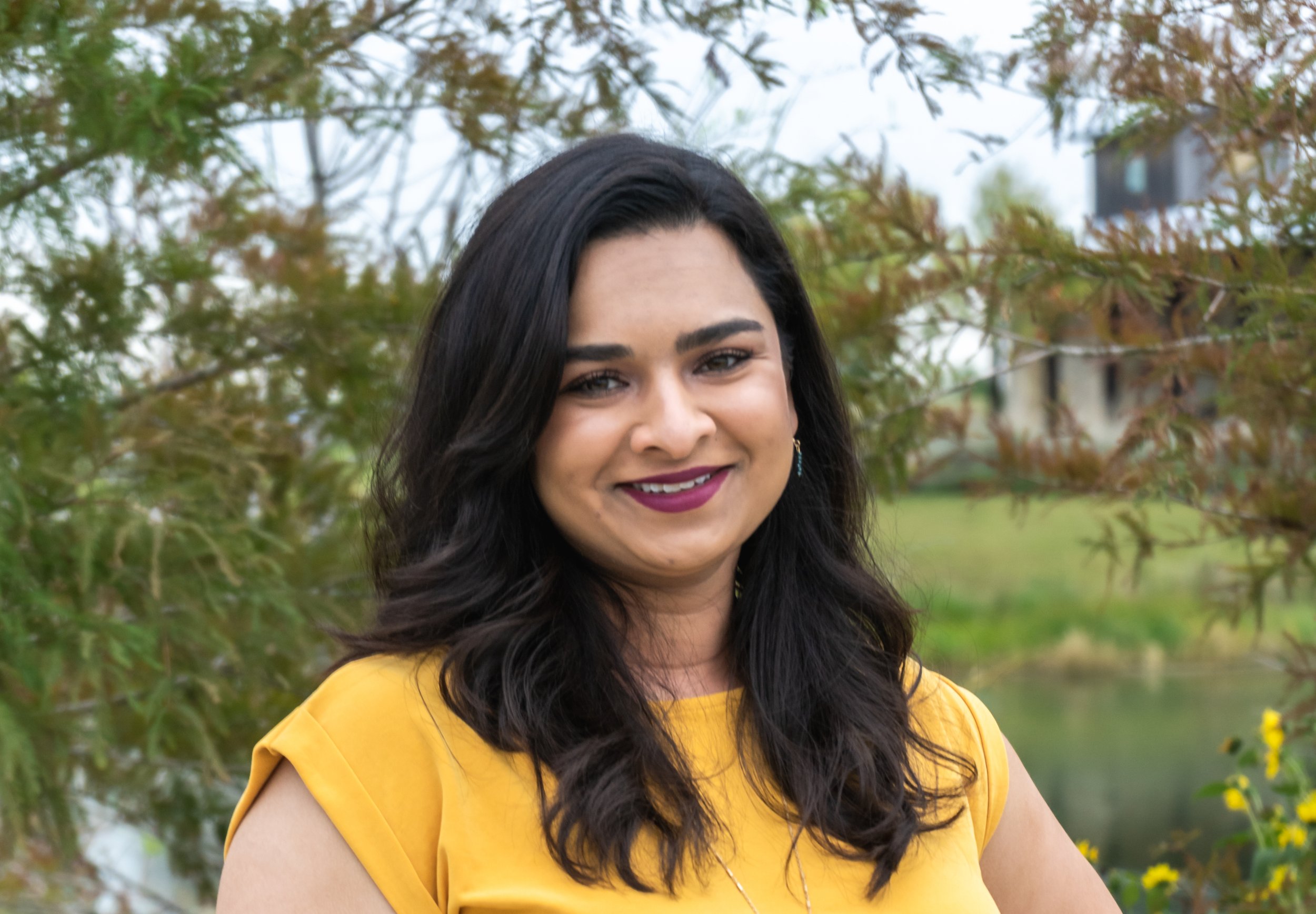
Surabhi Jagdish is a licensed psychotherapist with over 11 years of experience. She blends her clinical expertise with her lived experience as a child of immigrant parents, understanding firsthand what it's like to navigate the tension between achievement and emotional safety, independence and connection.
Using an integrative, trauma-informed approach that includes EMDR and Brainspotting, Surabhi supports individuals and couples navigating anxiety, complex trauma, depression, and relational wounds, and cultural stress or racial trauma. Her work is rooted in curiosity and reflection, helping clients move beyond survival toward more meaningful connections to themselves and their relationships.
